
Excited to run a challenge but you’re not totally sure what it should be about?
You see other business owners launching these amazing challenges, and you just know you could do it, too. But when you sit down to brainstorm, the pressure to find profitable online challenge ideas can be so overwhelming that you end up doing nothing at all.
If you are staring at a blank screen wondering how to create a paid challenge, here’s the thing: a great concept isn’t pulled out of thin air. It’s usually hiding in plain sight, right in the questions your audience is already asking you.
So, You Want to Create a Paid Challenge?
Paid challenges are one of the best ways to get your clients a quick win, build your authority, and bring in cash. But the first step, deciding on a topic, can feel like a huge hurdle.
Most of us freeze because we think we need some huge, groundbreaking, never-been-done-before idea. We don’t.
The goal isn’t to create a massive, life-altering program. The goal is to find one small, specific, solvable problem for one specific person. That’s it. And the best part? You already have everything you need to find it. The most successful challenge concepts are almost always hiding in what you already know and who you already talk to every day.
Step 1: Understand What Makes a Great Challenge Idea
The magic of a challenge is the “quick win.” It’s not your signature course or your high-ticket coaching program. A challenge is a powerful first step.
Think of it like an appetizer. It’s a delicious, satisfying taste that gets people excited for the main course. It should be focused on a tangible, specific outcome that people can actually achieve in a short amount of time, usually 3 to 7 days.
This is why a “small” idea is often more profitable than a “big” one. When a potential customer sees your paid challenge idea, they should be able to clearly picture themselves successfully completing it. A woman looking for a challenge topic might imagine her client easily achieving that one specific promised result, making the purchase an easy yes.
Trying to solve too big of a problem in a short challenge is a recipe for overwhelm, for both you and your participants. A small, clear promise is easier to market, easier to sell, and easier to deliver on. Wins all around.
Step 2: Map Out Where to Look for Your Topic
Ready to do a little treasure hunting? Your perfect challenge topic is probably closer than you think. Let’s dig in and find it. Grab a notebook and let’s explore a few key places.
- Dig into your digital conversations. Open up your DMs, your email “sent” folder, and the comments on your posts. What questions pop up over and over again? What are people always asking for your help with? These recurring questions are pure gold.
- Ask yourself what lights you up. What topics could you talk about all day long without getting bored? What are you truly passionate about teaching? Your own energy and excitement for a topic are contagious.
- Think about a recent “quick win.” What’s a small, “aha!” moment you’ve had recently, or one you helped a client achieve? Often, the solution to a problem that felt huge can be broken down into a simple, teachable process perfect for a challenge.
Look for the patterns. If you keep getting asked what your morning routine is, or how you organize your client files. That’s a potential challenge topic staring you right in the face.
Step 3: Gut-Check Your Challenge Concept
Once you have a few potential challenge concepts, it’s time to put them to the test. A quick gut-check now saves you a ton of time and energy later. Run your favorite idea through these four questions.
- Can you describe the promised result in a single sentence? A clear, simple promise is key. For example, “By the end of this 5-day challenge, you will have a week’s worth of social media content planned and scheduled.” If you can’t state the outcome simply, the idea might be too broad.
- Is this a problem your people are actively trying to solve? Are they Googling for answers or complaining about this specific issue? A great challenge solves a problem that your audience already knows they have.
- Can you break the solution into 3-7 simple, daily actions? Remember the “quick win” principle. Each day of your challenge should give your participant a clear, doable task that moves them forward. If it’s hard to break down, it might be too complex for a challenge format.
- Does this idea feel exciting and energizing for YOU to teach? This is crucial. Your enthusiasm is a huge part of what makes a challenge successful. If the thought of teaching this topic for five days straight makes you feel tired, put it aside and look for one that genuinely excites you.
Okay, Your Idea is Fabulous. What’s Next?
You’ve landed on a topic. Heck yes! Take a moment and celebrate, because that’s often the hardest part of the whole process. You’ve successfully sifted through all the potential paid challenge ideas and found one that feels right.
Now, it’s time to get that idea out of your head and onto paper so you can make it even stronger. This is the step where you get crystal clear on the details: the specific promise you’re making, exactly who it’s for, and the transformation you’re delivering.
This is precisely what the Challenge Idea Clarity Worksheet was designed for. It walks you through answering those foundational questions so you can build your challenge on a rock-solid, confident foundation.
It’s the very first step inside my Paid Challenge Planner Kit. The kit is your complete roadmap for getting your challenge idea out of your head and out into the world, helping you map out everything from your price and timeline to your daily content and promotional plan.
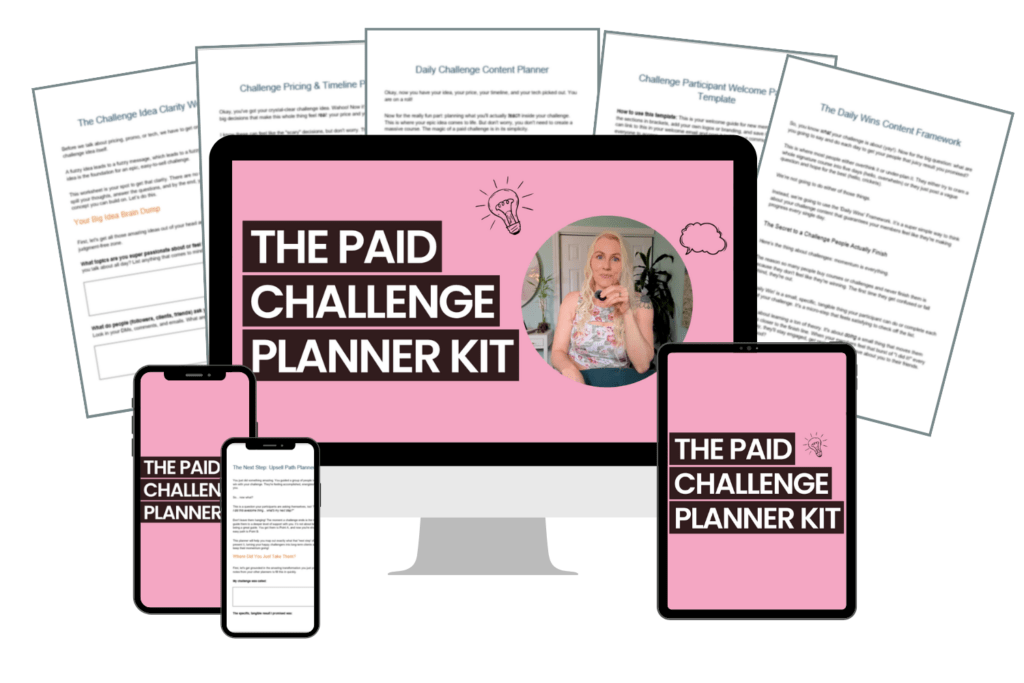 Grab The Paid Challenge Planner Kit
Don’t let that amazing idea sit on the back burner any longer. You found your topic, and that’s a huge win. Let’s keep the momentum going and turn that fantastic challenge idea into a reality.